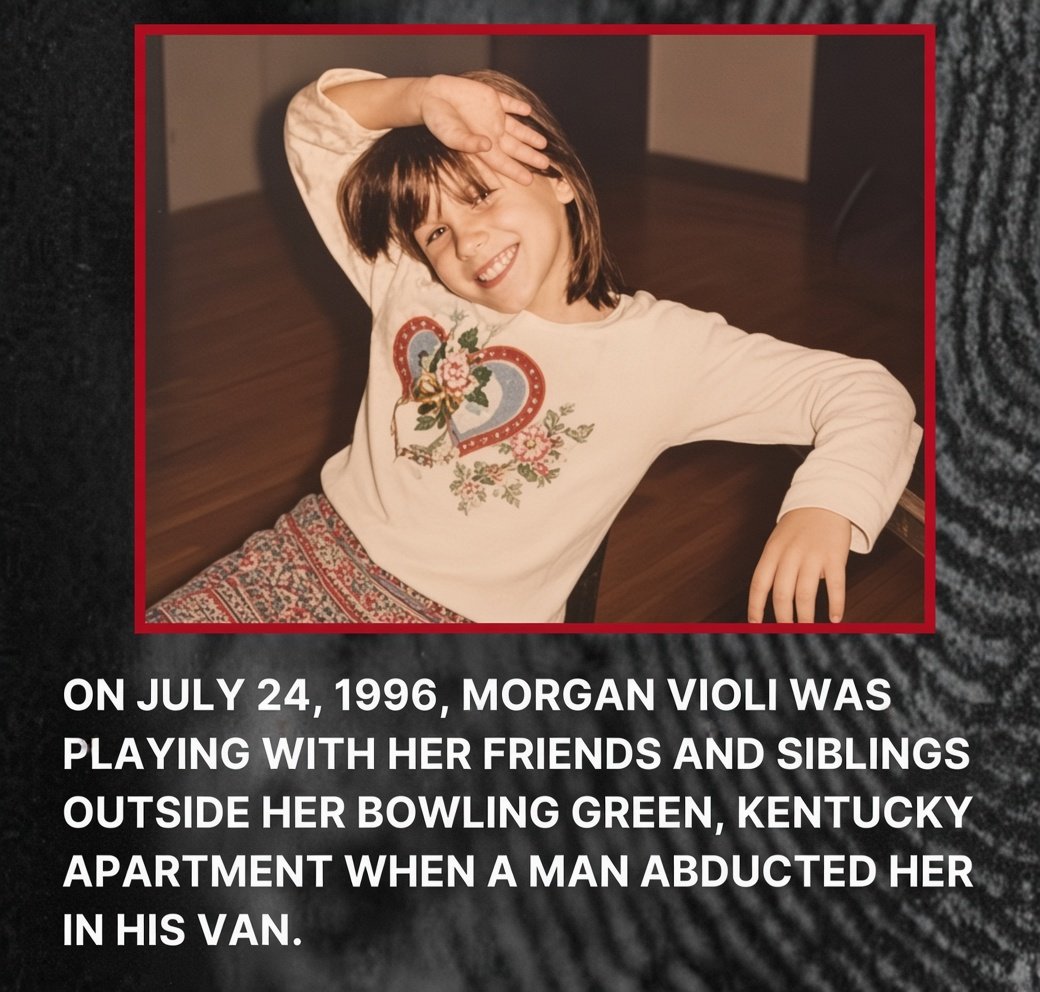
For nearly three decades, the abduction and murder of 7-year-old Morgan Violi haunted Bowling Green, Kentucky — a broad-daylight kidnapping witnessed by neighbors and even her own sister, followed by three months of agonizing uncertainty and then a devastating discovery in the Tennessee woods. For years, her killer’s identity was one of the state’s most enduring mysteries. As of 2026, that mystery has finally been solved.
An Ordinary Summer Afternoon
On the afternoon of July 24, 1996, Morgan Jade Violi was playing outside the Colony Apartments on Shive Lane in Bowling Green, where she lived with her mother and sisters. It was a hot Wednesday, the kind of day made for being outside, and Morgan was walking across the parking lot with a young friend, six-year-old Destiny Miller.
Just after 12:30 p.m., a maroon van pulled into the lot and stopped near the girls. A man got out and lunged first for Destiny — she wrenched free and ran, but stopped short when she realized the man had grabbed Morgan instead. Witnesses watched in horror as he forced Morgan into the passenger seat, climbed in after her, and sped out of the complex. Morgan’s older sister, Heather, heard her scream and, seeing Destiny running through the apartment buildings, initially thought the girls were simply playing — a small, aching detail she has carried with her ever since.
Neighbors called police immediately and gave a description of the van and its driver: a white man, believed to be in his twenties, unshaven. But by the time officers arrived, the van, and Morgan, were already gone.
A Trail That Went Cold
Investigators quickly determined that the van — a maroon 1978 Chevrolet — had been stolen out of Dayton, Ohio, the day before the abduction. It was found abandoned two days later at a truck stop in Franklin, Tennessee, just south of Nashville. Witnesses in Robertson County, Tennessee, also reported seeing a second, unrelated van parked for several hours near an old barn the day after Morgan disappeared — a detail that would later prove significant.
On October 20, 1996, nearly three months after Morgan vanished, her remains were discovered in a wooded area of Robertson County, not far from that same barn. The FBI opened a formal kidnapping and murder investigation and, over the years, offered a reward of up to $25,000 for information. Composite sketches of the suspect were circulated. Leads were chased down. None of them led anywhere. For the better part of thirty years, Morgan’s case remained unsolved, and her family was left without the answers every family in that position desperately needs: who, how, and why.
The Break: DNA, a Fiber, and a Fugitive
The case finally cracked open not because of a new witness or a deathbed confession, but because forensic science eventually caught up to the evidence investigators had preserved for decades. A fiber recovered near Morgan’s remains was matched to the cushions of the stolen van. A single strand of hair, recovered from inside that same van years earlier, had been kept in evidence — and as DNA technology advanced and national databases like CODIS expanded, that hair finally produced a usable genetic profile.
It led investigators to Robert Scott Froberg, originally from Dayton, Ohio. At the time of Morgan’s abduction, Froberg was not a free man living an ordinary life — he was a fugitive. In 1996, he had been serving a lengthy sentence in the Alabama Department of Corrections for a 1988 robbery in Montgomery when he escaped from custody that April. While on the run, he stole a car from an elderly woman and made his way to Mount Carmel, Pennsylvania, where he was recaptured in May 1996 after a young boy told his parents a stranger was hiding in a neighborhood treehouse.
Froberg didn’t stay in custody long. He escaped from the Pennsylvania jail on July 16, 1996. About a week later, on July 23, he stole a maroon Chevrolet van from a residential street in Dayton, Ohio — less than half a mile from his own parents’ home — and headed south.
According to the criminal complaint later filed against him, Froberg took Interstate 65 into Kentucky and pulled off in Bowling Green, reportedly looking to find drugs. He turned into the Colony Apartments, spotted Morgan and Destiny in the parking lot, and abducted Morgan. He then continued south on I-65 into Tennessee, exiting at White House and pulling over near a barn — the same barn Morgan’s remains would later be found close to. There, according to his own later admission, he killed her.
Justice, Nearly Thirty Years Later
On February 26, 2026, federal prosecutors filed a criminal complaint and arrest warrant in the U.S. District Court for the Western District of Kentucky, charging the now 61-year-old Froberg with kidnapping resulting in death. At a press conference the next day, U.S. Attorney Kyle Bumgarner told the Bowling Green community that Morgan’s family had never given up hope, and that investigators had spent years reexamining old evidence and applying new technology in pursuit of the truth. He also shared a detail that mattered deeply to those who had followed the case for decades: Morgan had fought back. She screamed. She resisted.
Froberg, who had been serving out an unrelated 40-year Alabama prison sentence connected to his 1988 robbery and later escapes, was formally indicted by a grand jury in March 2026 and transferred to a Kentucky detention facility. He made his first appearance in federal court in April, where he pleaded not guilty, as Morgan’s family looked on wearing purple in her memory.
That changed on July 22, 2026 — just two days before the 30th anniversary of Morgan’s abduction. Froberg appeared again in U.S. District Court in Bowling Green and pleaded guilty to one count of kidnapping resulting in death, formally admitting responsibility for taking Morgan from that parking lot and for her death in Tennessee. Under the terms of his plea agreement, Froberg is expected to receive a life sentence — in the federal system, one with no possibility of parole. His formal sentencing hearing is scheduled for November 2, 2026, in U.S. District Court in Bowling Green.
Thirty Years of Waiting, Finally Answered
For Morgan’s family, the resolution of this case closes a chapter that has spanned three decades of missed birthdays, missed milestones, and unanswered questions. It’s also a reminder of how much modern forensic science has changed what’s possible in cold cases — a single hair, preserved for nearly thirty years, was ultimately what connected a stolen van in Ohio to a fugitive who had already vanished back into the prison system, hiding in plain sight the entire time.
Morgan Violi would be in her late thirties today. Instead, her name will be remembered as one of Kentucky’s most heartbreaking cold cases — and, finally, as one that didn’t stay unsolved forever.